How Many Square Feet in an Acre?
Visualizing the most important land measurement in America
Quick answer: 43,560 square feet in 1 acre. Keep reading for the full breakdown.
One acre contains exactly 43,560 square feet. That number sounds completely random until you learn where it came from, and then it makes perfect sense. But first, the practical stuff: an acre is about 75% the size of an American football field. If you imagine a football field without the end zones and then shave off about a quarter, you are looking at roughly one acre.
Another way to picture it: a perfect square that measures about 209 feet on each side. Or a rectangle 100 feet wide and 436 feet long. Or a strip as wide as a two-lane road (about 24 feet) and a third of a mile long. Acres do not have a fixed shape, which is part of what makes them tricky to visualize. The same acre can be a square, a rectangle, a circle, or any other shape as long as the total area adds up to 43,560 square feet.
🏟️ Acre Size Comparisons
| Place or thing | Size in sq ft | How many acres |
|---|---|---|
| Tennis court | 2,808 | 0.065 (about 15 fit in an acre) |
| Basketball court | 4,700 | 0.108 (about 9 fit in an acre) |
| Hockey rink | 17,000 | 0.39 (about 2.5 fit in an acre) |
| Football field (no end zones) | 48,000 | 1.1 |
| 1 acre | 43,560 | 1.0 |
| FIFA soccer field | 76,900 | 1.76 |
| Typical city block | 100,000 to 200,000 | 2.3 to 4.6 |
| Walmart Supercenter floor space | about 180,000 | 4.1 |
📜 Why 43,560? The Medieval Math
The acre was originally the amount of land a farmer with a team of oxen could plow in a single day. English law standardized it as a rectangle one furlong (660 feet) long and one chain (66 feet) wide. Multiply 660 by 66 and you get exactly 43,560. These were not random dimensions. A furlong was the distance an ox team could pull a plow before needing to rest and turn around. A chain was the width of a standard plow strip. So the acre was literally defined by the physical limits of the animal doing the work.
The word "acre" itself comes from Old English aecer, meaning "open field." Before King Edward I standardized the acre in 1290, the actual size varied from region to region because some soils were harder to plow than others. A farmer working heavy clay might cover less ground in a day than one working light sandy soil, so their "acre" was physically smaller.
🏡 What Acres Mean for Home Buyers
If you are shopping for a house, lot sizes in acres will come up constantly. Here is what different sizes actually feel like to live on:
- 0.1 acres (4,356 sq ft): A tight urban lot. Room for a small house and maybe a patio, but neighbors are very close.
- 0.25 acres (10,890 sq ft): A typical suburban lot. Enough for a house, a yard, maybe a garden. This is what most people think of as a "normal" yard.
- 0.5 acres (21,780 sq ft): A large suburban lot. Room to throw a ball around, put up a swing set, and still have privacy from the neighbors.
- 1 acre: Feels spacious. You can have a big garden, a workshop, maybe a few fruit trees. Mowing the lawn takes about 45 minutes with a riding mower.
- 5 acres: This is where it starts to feel like rural property. You could raise some chickens, have a large garden, and not see your nearest neighbor from your porch.
The average American home lot is about 0.19 acres (roughly 8,250 square feet), though this varies wildly by region. In Manhattan a building lot might be 0.04 acres. In rural Texas a standard new home lot might be 0.5 acres or more.
🌍 Acres and Hectares
Most of the world uses hectares instead of acres. One acre equals 4,047 square meters or 0.4047 hectares. The simplest conversion to remember: 2.5 acres is about 1 hectare (it is actually 2.471 but close enough for converation). If you are reading international real estate listings or agricultural reports, this conversion will come up constantly.
🗽 Famous Places Measured in Acres
- Central Park, New York City: 843 acres, about the same as 637 football fields
- Disneyland: 85 acres, which is surprisingly compact
- Walt Disney World: 25,000 acres, roughly the size of San Francisco
- The Pentagon building footprint: 29 acres
- The White House grounds: 18 acres
- King Ranch in Texas: 825,000 acres, which is larger than the entire state of Rhode Island
💰 What Does an Acre Cost?
According to the USDA, the average value of US farmland in 2024 is about ,170 per acre. But that average hides enormous variation. Prime Iowa cropland averages ,900 per acre. New Mexico rangeland averages 30 per acre. Residential land near major cities can easily hit 00,000 or more per acre. In central Manhattan, land has traded at prices exceeding billion per acre, which means a single square foot of Manhattan dirt can be worth more than an entire acre of farmland in some states.
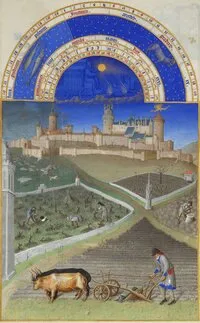
🏰 Medieval Farmers Measured Land by How Much an Ox Could Plow
An acre was originally defined as the amount of land a single farmer with a yoke of oxen could plow in one day. The shape was always a long, narrow strip, not a square, because turning a heavy plow with oxen was so difficult that farmers preferred to plow in long straight lines. The standard strip was one furlong (660 feet) long and one chain (66 feet) wide. This is also why fields in medieval England were organized in long parallel strips rather than neat squares. The furlong literally means furrow long , the length of one plow furrow before turning around.
The illustration shown here is from the Très Riches Heures du Duc de Berry, one of the most famous illuminated manuscripts in history, painted around 1415 by the Limbourg brothers. It depicts the month of March and shows a peasant guiding an ox-drawn plow through a field, exactly the kind of labor that defined what an acre was. In the background stands the Château de Lusignan. The manuscript is now in the Musée Condé in Chantilly, France.
King Edward I standardized the acre to its current 43,560 square feet in 1290. Before that, an acre varied by region because clay soils were harder to plow than sandy ones, meaning a day's work produced less turned earth. The standardization was one of the earliest examples of a government imposing uniform measurement , centuries before the metric system attempted the same thing.
Join the conversation
Already have an account? Log in